Top Cars of All Time 10 Legendary Vehicles Changed History


What makes a car truly great? Is it raw, unadulterated speed? Is it a timeless design that makes you stop and stare? Or is it the sheer volume of units sold, proving that it perfectly met the needs of the masses?
The truth is, the “greatest” cars of all time are a diverse group of machines. Some shifted the paradigm of manufacturing, others redefined our expectations of speed, and a few became intrinsic parts of global culture. Narrowing down over a century of automotive history into a single list is no easy feat, but certain vehicles undeniably changed the trajectory of the industry forever.
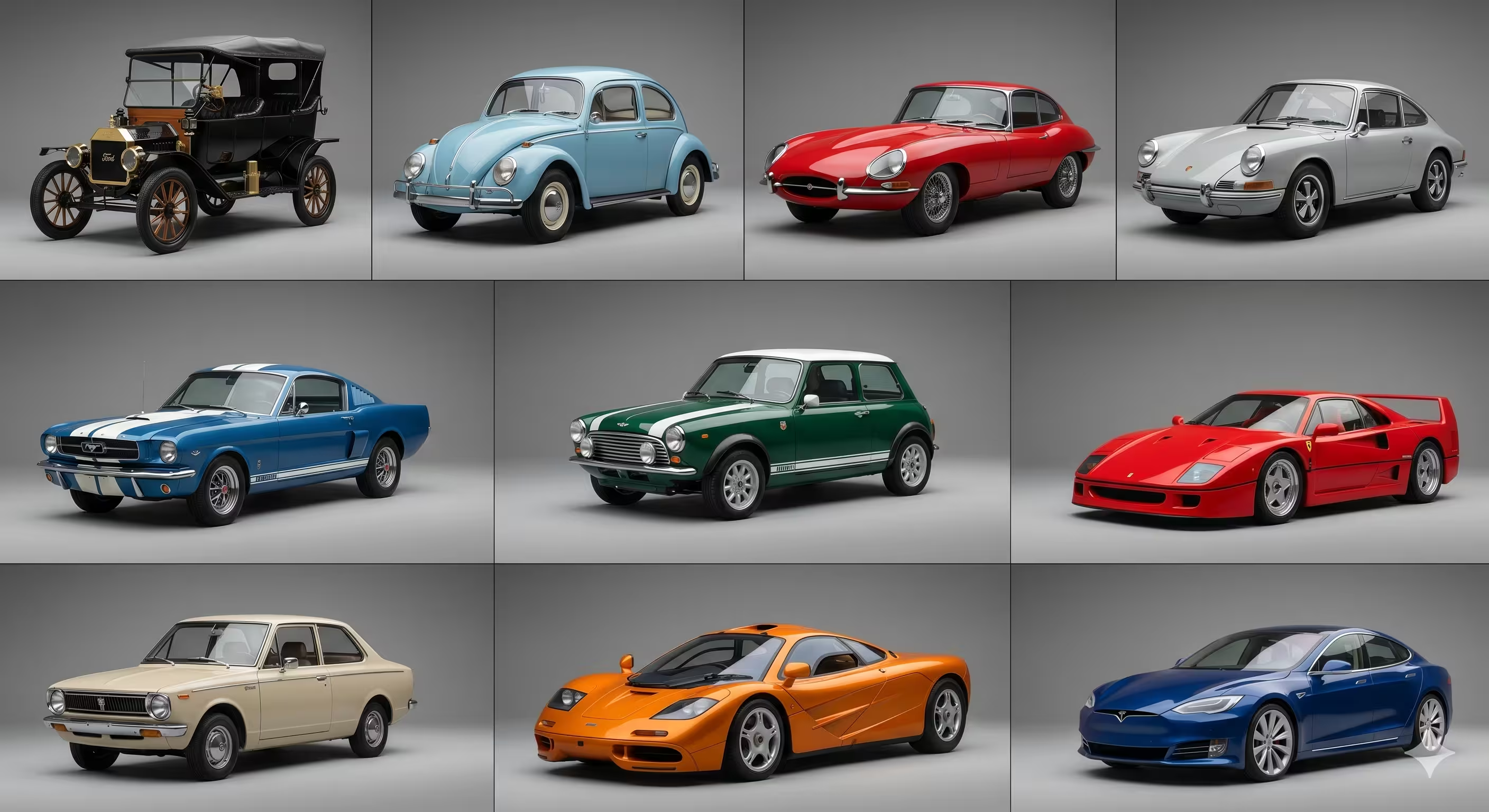
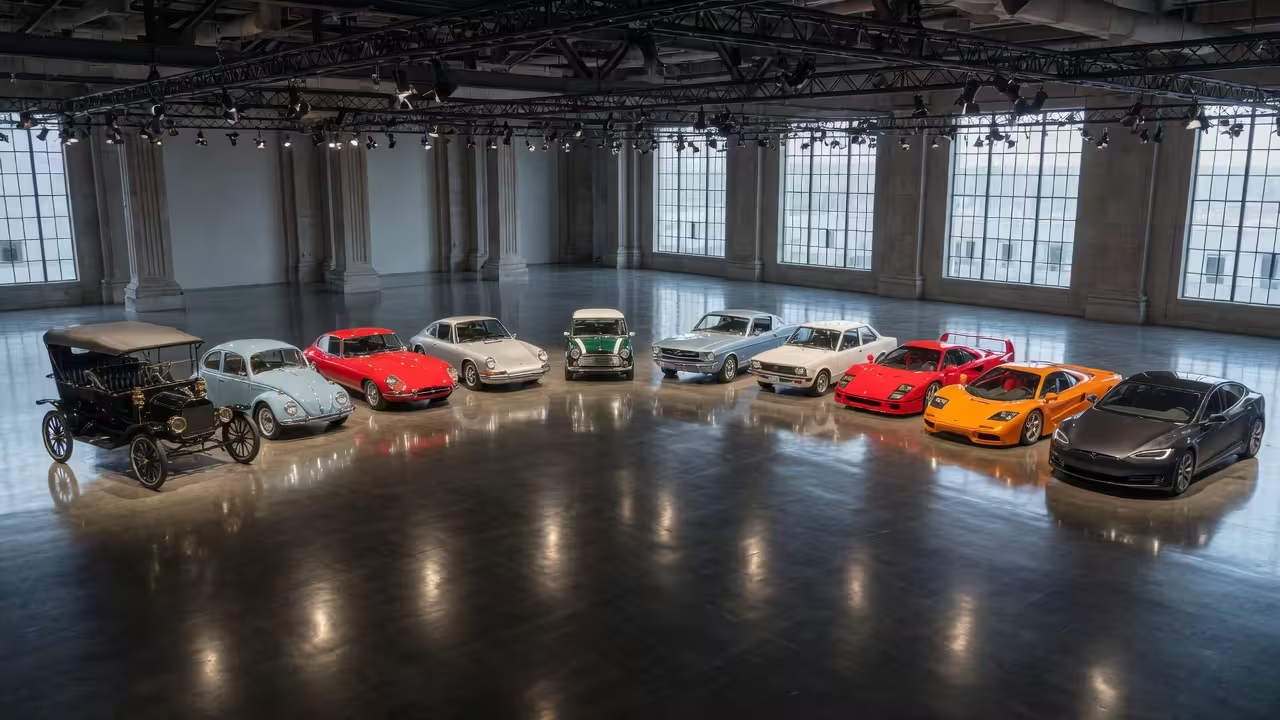
Here is a look at the top 10 most significant, iconic, and greatest cars of all time.
1. Ford Model T (1908–1927)
The Legacy: The Car That Put the World on Wheels
No list of automotive greats is complete without the Ford Model T. It wasn’t the first automobile ever made, nor was it the fastest or most luxurious. However, it was the most important. Henry Ford’s vision was to build a “motor car for the great multitude,” and to achieve this, he revolutionized manufacturing by perfecting the moving assembly line.
This innovation drastically reduced the time it took to build a car, plummeting the price to a point where the average factory worker could afford one. The Model T transformed the automobile from a plaything for the ultra-rich into an essential tool for everyday life. It reshaped infrastructure, spurred the creation of highways, and fundamentally altered global economics.
2. Volkswagen Beetle (1938–2003)
The Legacy: The Ultimate People’s Car
The origins of the Volkswagen Type 1—affectionately known as the Beetle—are rooted in pre-war Germany, but its legacy is one of global democratization and pop-culture triumph. Designed with simplicity, durability, and affordability in mind, its rear-mounted, air-cooled engine and distinctive bug-like shape made it an instant global phenomenon.
In the 1960s, the Beetle became an icon of the counterculture movement, a playful rebellion against the massive, chrome-laden land yachts of the era. It remained in production for an astonishing 65 years, with over 21 million units manufactured, making it the longest-running and most-manufactured car of a single platform ever made.
3. Jaguar E-Type (1961–1975)
The Legacy: The Most Beautiful Car in the World
When the Jaguar E-Type debuted at the 1961 Geneva Motor Show, it caused an absolute sensation. Even Enzo Ferrari, a man not known for handing out compliments to rivals, reportedly called it “the most beautiful car ever made.”
But the E-Type was not just a pretty face. It offered supercar performance—a claimed top speed of 150 mph and a 0-60 mph time of under 7 seconds—at a fraction of the price of an Aston Martin or a Ferrari. It combined breathtaking aesthetics with independent rear suspension and all-around disc brakes, setting a new benchmark for sports cars and defining the swinging sixties in Britain.
4. Porsche 911 (1964–Present)
The Legacy: Evolution Over Revolution
In the automotive world, the Porsche 911 is the ultimate survivor. Introduced in 1964, it featured an unconventional layout: the engine hung out over the rear axle, a design that critics argued was fundamentally flawed. Yet, Porsche engineers spent the next six decades stubbornly perfecting it.
The 911 is the blueprint for the everyday sports car. It offers a unique driving dynamic, incredible reliability, and a silhouette that has remained instantly recognizable for generations. From the original air-cooled classics to the hyper-advanced, twin-turbocharged water-cooled monsters of today, the 911 proves that if you get the recipe right, you don’t need to start from scratch—you just keep refining.
5. Mini Cooper (1959–2000)
The Legacy: A Masterclass in Packaging
Born out of a fuel shortage crisis, the original Mini, designed by Sir Alec Issigonis, was a marvel of spatial efficiency. By pushing the wheels to the absolute corners of the chassis and mounting the engine transversely (sideways), Issigonis created a tiny car that could comfortably seat four adults.
This layout became the gold standard for virtually every compact car that followed. But the Mini wasn’t just practical; its light weight and low center of gravity made it handle like a go-kart. When John Cooper got his hands on it, the Mini Cooper was born, famously slaying larger, more powerful cars to win the prestigious Monte Carlo Rally multiple times in the 1960s.
6. Ford Mustang (1964–Present)
The Legacy: The Birth of the Pony Car
When Lee Iacocca and his team at Ford introduced the Mustang, they didn’t just launch a car; they created a cultural phenomenon and an entirely new automotive segment—the “pony car.” Aimed at young, post-war boomers, the Mustang was affordable, customizable, and exceptionally stylish.
It featured a long hood, a short deck, and an options list long enough to allow buyers to build anything from a frugal commuter to a fire-breathing V8 muscle car. The Mustang captured the spirit of American freedom and rebellion, starring in iconic films like Bullitt and cementing itself as a global symbol of Americana.
7. Toyota Corolla (1966–Present)
The Legacy: The Benchmark of Reliability
If the Model T put the world on wheels, the Toyota Corolla kept it moving without breaking down. Surpassing the Beetle as the best-selling nameplate in history (with over 50 million sold to date), the Corolla’s brilliance lies not in face-melting speed or avant-garde design, but in absolute, bulletproof dependability.
The Corolla made car ownership painless. It offered great fuel economy, sensible ergonomics, and an engineering ethos that meant it simply refused to die. It represents the democratization of reliable mobility, earning the trust of families, commuters, and delivery drivers on every continent.
8. Ferrari F40 (1987–1992)
The Legacy: The Purest Supercar
Built to celebrate Ferrari’s 40th anniversary, the F40 was the last car personally approved by Enzo Ferrari before his death. It was designed with a singular focus: raw, visceral performance. There were no driver aids, no stereo, no heavy carpets, and no door handles—just a pull string to get out.
Powered by a ferocious 2.9-liter twin-turbocharged V8, the F40 was the first production car to break the mythical 200 mph barrier. Its striking Kevlar and carbon-fiber bodywork, dominated by that massive rear wing, made it the ultimate bedroom poster car of the 1980s. It remains the gold standard for analog, terrifying, and exhilarating supercars.
9. McLaren F1 (1992–1998)
The Legacy: The Ultimate Hypercar
When legendary Formula 1 designer Gordon Murray set out to build the ultimate road car, he accepted zero compromises. The McLaren F1 was the first production car to use a carbon-fiber monocoque chassis. It featured a naturally aspirated BMW V12 engine lined with real gold foil for heat reflection, and a unique central driving position with a passenger seat flanked on either side.
In 1998, the McLaren F1 set the record for the world’s fastest production car, hitting 240.1 mph—a record it still holds today for a naturally aspirated car. It was so far ahead of its time that it took over a decade for another manufacturer (Bugatti) to surpass its top speed, and it remains the holy grail for automotive collectors.
10. Tesla Model S (2012–Present)
The Legacy: The Catalyst for the Electric Revolution
Before the Model S, electric vehicles (EVs) were largely seen as glorified golf carts—slow, quirky, and severely range-limited. The Model S shattered that perception overnight. It proved that an electric car could be a beautiful, luxurious, long-range cruiser capable of out-accelerating million-dollar supercars.
With its massive touchscreen interface, over-the-air software updates, and the proprietary Supercharger network, the Model S fundamentally altered consumer expectations and forced every legacy automaker on the planet to pivot toward electrification. It is undeniably the most important car of the 21st century.
Conclusion
The automotive landscape is constantly shifting. We are currently navigating a massive transition from internal combustion to electric power, and eventually, to autonomous driving. Yet, looking back at these ten mechanical marvels reminds us of the ingenuity of human engineering.
From the mass-market genius of the Model T to the uncompromising speed of the McLaren F1, these cars didn’t just reflect the eras in which they were built—they helped define them. As long as humanity has a desire to explore, the automobile will remain one of our greatest canvases for innovation.